
How to Search Criminal Dockets
Case.net is the online home for public Lafayette County criminal docket material. Use Case.net and search by Lafayette case number when you have one. A name search works as a starting point. Protected cases and protected names can limit what it returns, though. Filing Date Search fits a defined Lafayette County and date range. Scheduled Hearings & Trials Search is the route for current Lafayette settings. Before calling a result a match, check three things. Confirm the Lafayette County header. Check the Lafayette division and the criminal category.
If the online docket comes up short, the fallback chain is simple. The Lafayette County Circuit Clerk can help. A public terminal may sit inside a Lafayette courthouse. An in-person look and the proper court-record route are also options. A written request can go through the Lafayette County record-search form. It covers defined criminal disposition categories. A Lafayette County Sunshine request addressed to the Circuit Clerk is the other route. The clerk can also explain why a document is not available remotely. It may not be attached, not public, or need a different Lafayette access method.
- Open Case.net and choose the search route for the Lafayette criminal matter: Case Number, Litigant Name, Filing Date, or Scheduled Hearings & Trials.
- Narrow the search to Lafayette County and the likely Lafayette criminal court or division.
- Open the matching Lafayette case header and confirm the style, filing date, category, and status.
- Read Lafayette entries from the first charge or filing through later settings, orders, plea, judgment, or disposition.
- Call the Lafayette County Circuit Clerk for public-terminal access, inspection, copies, certification, or a focused Lafayette request when the public viewer cannot answer the question.
Lafayette County Criminal Docket Search
Missouri runs its courts on the Judicial Information System, called JIS. Lafayette County criminal cases live inside it. Public information flows out through Case.net. The Lafayette Circuit Clerk general court information page describes JIS as the statewide operational system. It points public users to Case.net for Lafayette searches. None of that replaces the clerk. The Lafayette clerk keeps the local record path. Case.net remains the online portal for public docket structure.
The official Case.net public guide confirms the search routes covered here. The live portal is built for a human session. Read Lafayette labels and filters as they appear when you search. One caution: never add sensitive personal identifiers. A missing name result does not justify them.
| Search route | Best use | Practical check |
|---|---|---|
| Litigant Name Search | When a Lafayette party name is known | Confirm Lafayette County, case category, and header details because protected names may be omitted. |
| Filing Date Search | A defined Lafayette county or division filing window | Use the displayed Lafayette date range and verify the case category. |
| Case Number Search | When the Lafayette court identifier is known | Usually the clearest route for a specific Lafayette docket, especially where a name is restricted. |
| Scheduled Hearings & Trials | Upcoming Lafayette court settings | Recheck the Lafayette event before travel because a setting can change. |
Lafayette County Criminal Docket Codes
CR is the standard Missouri category code for Lafayette criminal cases. Missouri Court Operating Rule 4 sets up the statewide case-information system. It also builds the category structure behind a Lafayette County criminal docket lookup. Older Lafayette case numbers look different. They may pair a two-letter type code with a sequence number. Newer formats can add location and category segments. The identifier helps you pull the case. But the Lafayette case header and its dated entries are what actually explain what happened.
- CR
- The common case-category code for a Lafayette criminal matter in Missouri's court system.
- Arraignment
- A Lafayette criminal proceeding where the charge is addressed and a plea or later setting may be entered.
- Plea
- A defendant's formal response to a Lafayette criminal charge, such as guilty or not guilty.
- Disposition
- The recorded Lafayette outcome of a charge or case component, including dismissal, plea, judgment, or another resolution.
- Judgment
- The Lafayette court's formal adjudication or final determination shown in the record.
Beyond codes, a Lafayette County criminal docket can hold a warrant-related entry, a motion, a hearing notice, an order, a sentence, or post-judgment activity. Read each entry in context and by date.
What a Criminal Docket Shows
A Lafayette County criminal docket opens with case identity and then records events in order. The header may list the county, court, division, case category, style, filing date, and status. From there, the entries stack up. They can include a charging document, a summons or warrant-related event, arraignment, and plea. Motions, preliminary hearings, trial settings, judgments, sentences, and later activity can also appear. A title alone tells you little. Read any public linked order or judgment in that Lafayette case together with its date.
| Case number | The Lafayette court identifier, often using a criminal category such as CR. |
|---|---|
| Charge entry | A filed accusation or charging event in a Lafayette case. It is not the same as a finding or final disposition. |
| Hearing setting | The displayed Lafayette arraignment, pretrial, preliminary hearing, trial, or other scheduled event. |
| Motion or order | A party's request in a Lafayette case or a direction entered by the court during the case. |
| Plea or judgment | A later Lafayette entry that can show a plea, adjudication, dismissal, or other recorded resolution. |
| Linked document | A hyperlink can lead to a Lafayette public attachment at the user's permitted access level; a plain entry may have no public attachment. |
Lafayette County Criminal Docket Entries
A filed charge is not a finding. The Lafayette criminal docket may start with an information, indictment, summons, or another charging event. Later entries tell more. It can show a plea, verdict, dismissal, suspended-imposition-of-sentence entry, judgment, sentence, or some other disposition. Do not draw a conclusion from an allegation or the first event alone. The court's recorded action appears later. It shows up in the order, judgment, or disposition entry when it is public.
Read the sequence: A charge explains what was filed; a disposition, judgment, dismissal, plea, or sentence records a later court result.
The Lafayette County record-search form honors that same line. It offers disposition-only criminal searches. That option suits a defined court-record request. It does not replace reading the actual Lafayette public docket entries or ordering the proper court copy.
Lafayette County Criminal Docket Documents
One distinction matters a lot for Lafayette County criminal docket reading. The Missouri Courts File Viewer help explains it. A hyperlinked docket entry can signal a document attachment. The viewer may open it at its permitted access level. A plain entry may have no public attachment. Neither pattern proves a document exists, does not exist, or is open to everyone.
| Docket display | What it can mean | Next public step |
|---|---|---|
| Hyperlinked entry | A public document may be attached and available at the user's access level. | Open the link and confirm the document date, category, and public status. |
| Plain entry | No public attachment may be present, or the viewer may not display one. | Read the entry itself, then ask the clerk about public inspection if the document is needed. |
| ECASE or secure indicator | The case is electronic or the document has a security restriction. | Use the courthouse terminal or the clerk's instruction for the applicable access path. |
Stages on a Criminal Docket
A Lafayette County criminal docket can pass through several settings before any outcome. The usual public sequence runs filing, arraignment, pretrial activity, plea or trial, disposition, and sentencing. Other entries can appear along the way. A preliminary hearing, motion, continuance, or post-judgment entry are the usual examples. Exact order and public detail vary. They depend on the case and the court's entries.
Docket flow: Filing → Arraignment → Pretrial → Plea or Trial → Disposition → Sentencing
A hearing date marks an event, not an outcome. Before counting on it, read the latest Lafayette County criminal docket entry and the Scheduled Hearings & Trials result, since settings can shift after the calendar posts. When a date looks changed or unclear, confirm it with the Circuit Clerk.
Lafayette County Criminal Court Paths
Every Lafayette County criminal docket sits in one of the local divisions. The division map tells you which one. Division One handles circuit work, the main circuit-court track for felony-level matters. Division Three covers associate and small-claims cases. Ordinance and traffic tickets may run through a city municipal court. A few listed municipalities route them to the Associate Circuit Division instead. Labels alone will not settle it. The case header, the citation, and the issuing court point to the right route. They beat the word "criminal" every time.
| Local route | Role in the court structure | Public search path |
|---|---|---|
| Division One | Lafayette County circuit division | Case.net for public case information, then the Circuit Clerk for record help. |
| Division Three | Associate division, including assigned municipal matters | Case.net and the Circuit Clerk, with city confirmation when a municipal citation is involved. |
| Municipal court office | City ordinance or traffic matter where the city retains the case | The city's official court contact, citation, and Case.net where public information is available. |
The county lays out all three divisions and their court locations on the Lafayette County court services page. Checking it first can spare you a trip to the wrong counter for criminal docket information.
Lafayette County Criminal Docket Requests
A precise request beats a broad one. The local record-search form splits outcomes into two boxes. One is "Circuit Criminal Dispositions Only." The other is "Associate Criminal Dispositions Only." That lets you name the court level rather than ask for everything at once. Include a case number, division, date range, or caption if you have one. The form spells out its result fields for office use: case number, style, date, and clerk. If the work cannot be finished on the spot, you may hear back by phone or mail.
Do not confuse a court-file search with a statewide criminal-history report. Different offices hold them. The Lafayette County clerk FAQ covers this. It sends anyone wanting a statewide criminal-history report to the Missouri State Highway Patrol. A court docket request should stay narrow. Aim it at the specific Lafayette County criminal record or disposition you need. The clerk's office sits in Lafayette Hall, 116 South 10th Street, Lexington, Missouri 64067. It answers the phone at 660-259-6101.
For anything broader, take the Lafayette County Sunshine request route. Pick Circuit Clerk (Courts) as the department when it fits. Records on hand generally draw a response by the end of the third business day. When a record is unavailable, the county sends an explanation. It also gives the earliest date it can be produced.
Which Court Holds Criminal Dockets
The Lafayette County Circuit Clerk is the office to contact for criminal court records. Division One is the circuit division, while Division Three provides the associate division route. One caution matters here. The Fifteenth Judicial Circuit covers both Lafayette and Saline counties. Check the county and division. Do not rely on the circuit number alone. A shared circuit label never proves a case belongs in Lafayette County.
Case.net carries public criminal case information when it is public. A visitor in person can ask the Circuit Clerk. Ask about public access equipment. The clerk can also explain the proper request process. Office hours run 8:00 a.m. to 4:30 p.m. Monday through Friday, closed on state holidays. The official office details on the clerk's contact page include the general court email. Use them for records inquiries.
Lafayette County Criminal Docket History
Older Lafayette County criminal indexes still matter in a digital age. The local record-search form lists JIS for 2002 to the present. JIX circuit records cover 1994 to 2002. It also names scanned records and associate criminal index cards among the historical sources. So Case.net is only one piece of the route. It matters when a criminal court-record request is older or narrow.
Ask the Circuit Clerk which historical source fits your case. Never assume a public online result is the whole local record. Fees are modest. Copies cost 25 cents per page. Certification runs $2.50. With its defined search categories, historical sources, and set result fields, the printed form serves a focused court-record request far better than a broad hunt for personal information.
Public Access and Sealed Criminal Dockets
Missouri's Sunshine Law, RSMo 610.011, favors open records as public policy. That policy does not unlock every Lafayette County criminal docket document. Missouri Court Operating Rule 2 governs public access. It covers court records and public equipment. Access through File Viewer differs too. It depends on whether you are a public user, a registered e-filing attorney, or court personnel. Even a public case can hold confidential material. A name or document missing from public view proves nothing about whether a case exists.
Criminal-record access rules:
RSMo 610.011 supplies the Sunshine Law's public-access policy while allowing legally authorized exceptions.
Missouri Court Operating Rule 2 is the court-record and public-access-equipment framework.
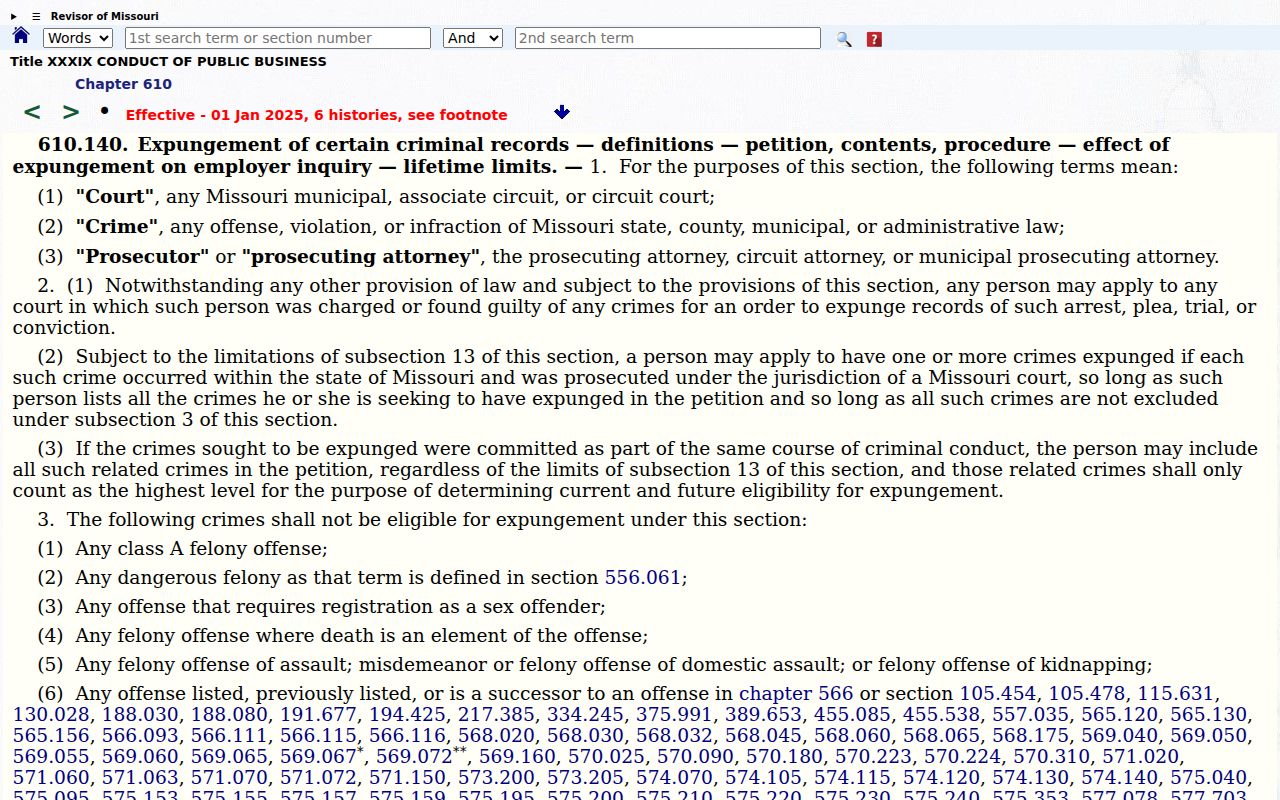
RSMo 610.140 provides the expungement process and confidentiality consequence described by the statute.
Expungement is not the same as an empty search result. The Missouri expungement statute is the authority behind the Lafayette County criminal docket example here. It sets out a petition and notice framework and spells out how confidentiality works after an expungement.
When public access is uncertain, ask first. Request the redacted public version if one applies, and ask the clerk which rule or order governs the file. A certified court copy carries weight that no Case.net screen or general online result can match.
Lafayette County Criminal Docket Boundaries
Several categories of material sit outside a Lafayette County criminal docket search. Think juvenile cases, mental-health records, and anything sealed or expunged. Files touching abuse, stalking, victims, or witnesses get the same protection. The File Viewer help page lists these confidential document categories. It also notes that a secure indicator can flag restricted material. Separately, the eFiling guidance covers some eCase documents. Those are only viewable at a public terminal inside a local courthouse. So the layers stack up. Public metadata is one thing. Public documents are another, restricted documents a third, and in-person access a fourth.
When a name search comes back empty or locked, take the case number or a tight case description to the Circuit Clerk. An unreturned search does not mean no court matter ever existed. For a broader walkthrough, the county's Lafayette County case search route covers general lookups. The clerk remains the stop for court-file access or certification.
Note: A public terminal may provide the appropriate access path for an electronic case. It does not change the restrictions that apply to confidential documents.